PRECAST & PRESTRESSED CONCRETE
Product overview
The use of alternate products should be considered for short span and/or non highway bridges. Double Tee and/or Channel sections can provide very economical solutions. The IT section provides a good alternate for short to medium spans where delivery, site access, or unit weights may be a concern.
PLANT
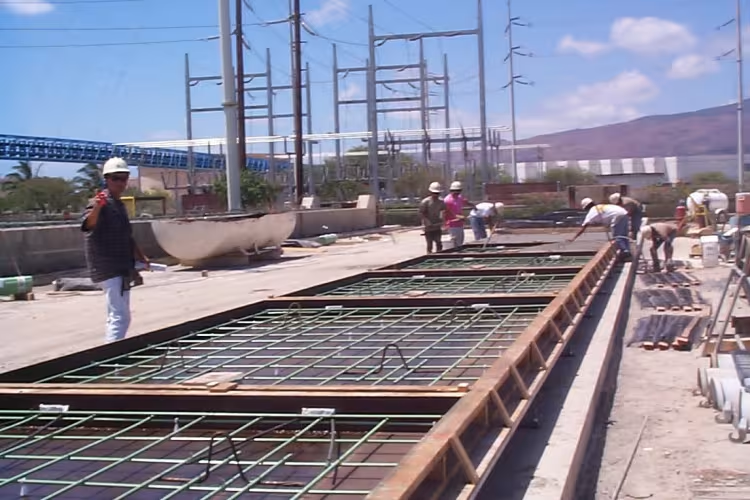
Steel forms are generally used for bridge related products. Dimensional constraints apply, although some adjustment to certain products may be available and should be discussed with GPRM Prestress.
Key specifications
| Related section | Source detail | Typical use |
|---|---|---|
| T bridge sections (M1) | Double tee / triple tee derived sections | Short spans and secondary traffic |
| Inverted T bridge girder (M3) | 12 to 36 in section depth shown | Short to medium spans |
| Stormwater infiltrator / drainage channel (M2) | Double tee section | Span and topping selected for project |
Design & detailing notes
- The M1 sheet describes economical T sections for short-span secondary traffic. Topping is selected for the application, usually 5 to 6 in; prefinished decks can be considered for access and pedestrian bridges.
- The M3 section is a lightweight option where transportation, equipment or site access are constraints. Its depth/span chart assumes adjacent units forming a continuous soffit.
- The M2 sheet illustrates spanning drainage channels with double tee sections and project-designed topping and reinforcement. Existing channels require new abutment supports.
- Steel forms impose dimensional constraints. Coordinate available adjustments, loads, span and site access with GPRM.
- SHT M-1 AND M-3.PDF: M1, M3
- M2.pdf: M2
This summary supports preliminary product selection. Refer to the complete source drawings and coordinate final dimensions, loads and reinforcing with GPRM and the project engineer. The supplied sheets do not show an issued or revised date.